 ParkWise
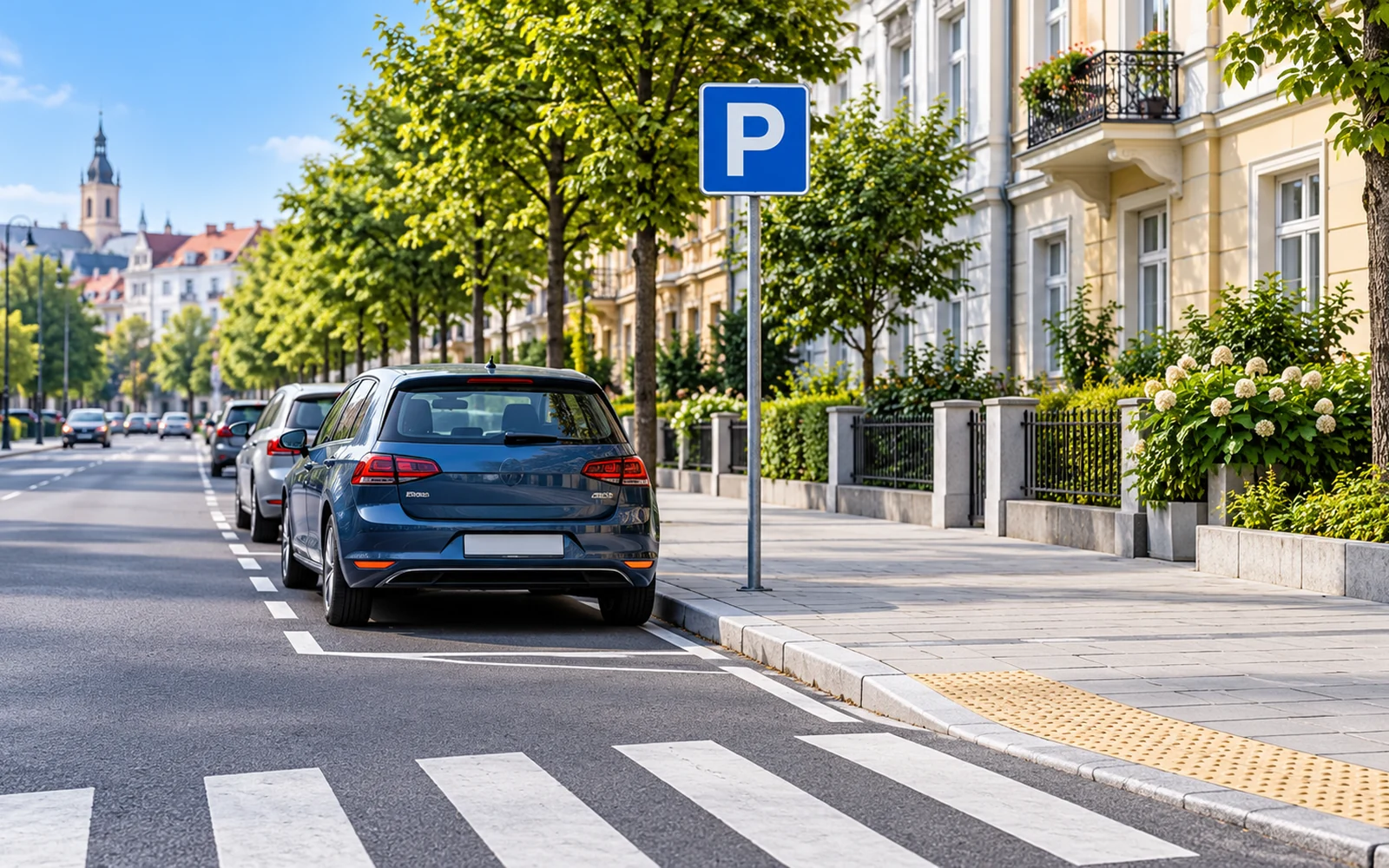
Crossings, junctions and bus stops: how much space to leave?
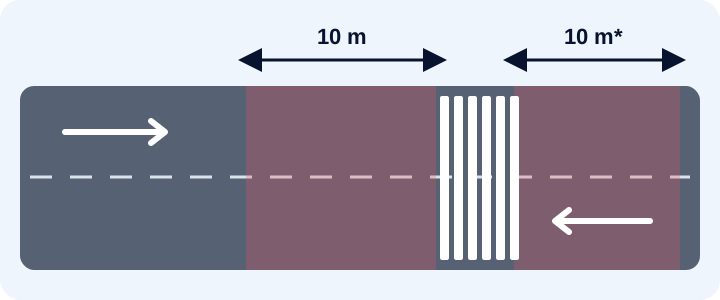
It is not enough to check whether the car is outside the painted lines. Polish traffic law sets areas where you must not stop or park. A voluntary brief stop — for example, dropping off a passenger — can also breach the restriction; a vehicle halted because of traffic conditions or traffic rules is treated separately. These diagrams are illustrative and not to scale.
Pedestrian and cycle crossings
Do not stop on a crossing or less than 10 m before it. On a two-way road with two traffic lanes, the restriction also applies for 10 m beyond the crossing. Assuming the far side is always allowed is a common mistake.
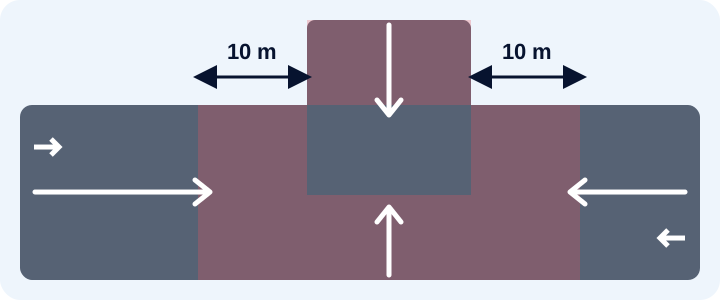
Junctions
Stopping is prohibited at a junction and less than 10 m from it. Check the side roads too: an apparently open spot just around the corner may still fall within the restricted area.
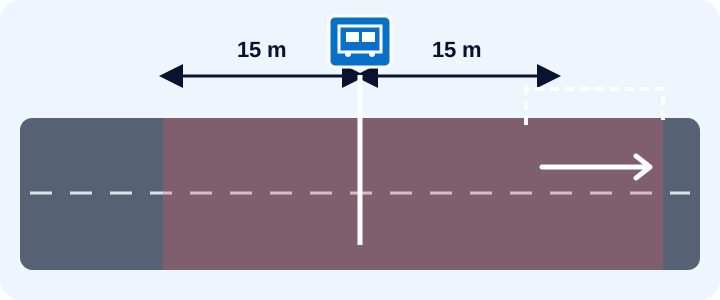
Bus stops
Do not stop within 15 m of the post or sign marking a stop. If the stop has a bus bay, the restriction covers the entire bay, not just the section beside the post.
Common mistakes
- Checking only where the wheels are and forgetting the area before a crossing.
- Thinking a quick passenger drop-off is allowed. A voluntary brief stop is still a stop.
- Applying the 10 m rule to bus stops, where the distance is 15 m.
- Treating a bus bay like an ordinary shoulder even though the restriction covers the whole bay.
A vehicle immobilised because of traffic conditions or traffic rules is a separate situation covered by the law. Otherwise, check the signs and keep crossings, sight lines and access to the stop clear.
Planning a stop? Open ParkWise and check parking options nearby before entering the area around a crossing or junction. Choose a car park, then confirm the rules on the signs and supplementary plates when you arrive.
Legal basis: Articles 2(29)–(30) and 49(1)(1), (2) and (9) of the Polish Road Traffic Act. See also Polish Police guidance on clearance from crossings.
Common parking mistakes
A small misjudgment can block sight lines or make it harder for pedestrians and transit passengers to move safely.
Estimating by eye
It is easy to misjudge the restricted area near a crossing or junction. Consider the whole vehicle and its position relative to the signs and markings.
“Just for a moment”
A voluntary stop, such as dropping off a passenger, is still subject to no-stopping rules. A brief stop is not automatically an exception.
Overlooking a bus bay
If a stop has a bus bay, do not leave your car anywhere within it. The restriction applies to the entire bay, not only the area beside the post.
Check a space before parking
Before leaving your car, check:
- you are not on a crossing or junction, or within the required clearance;
- you are at least 15 m from the bus-stop post or sign and are not blocking a bay;
- signs, supplementary plates and road markings do not add restrictions;
- your vehicle does not obstruct sight lines or pedestrian access.
In a busy area, open ParkWise to check parking nearby. Choose a marked space and confirm the rules on site.
Frequently asked questions
How far from a pedestrian crossing must I park?
At least 10 m before it. On a two-way road with two traffic lanes, the restriction also applies beyond the crossing.
What distance applies at a junction?
Stopping is prohibited at a junction and less than 10 m from it.
How far from a bus stop can I park?
At least 15 m from the post or sign marking the stop. If there is a bay, the restriction covers its entire length.
Can I stop briefly to drop someone off?
A voluntary brief stop is still a stop. If stopping is prohibited, choose another place.
Legal basis
These distances come from Article 49(1)(1), (2) and (9) of Poland’s Road Traffic Act. Always check the current signs at the location.
Check parking in ParkWise before stopping on the street
Open ParkWise, see car parks nearby and choose a spot away from crossings, junctions and bus stops. When you arrive, confirm that signs and supplementary plates allow parking.
Open ParkWise and check parking